Congratulations Nicola on your paper, maybe the best “islands of divergence” paper with actual data to date! see:
Congratulations Nicola on your paper, maybe the best “islands of divergence” paper with actual data to date! see:
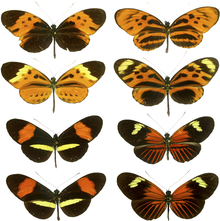
The first is from Contamana, Rio Ucayali, Peru, Oct 2008. The second from Puerto Marona, Ecuador, Sep 2011


Recently seen in a reference list:
Consortium HG (2012) Butterfly genome reveals promiscuous exchange of mimicry adaptations among species. Nature 487: 94-98
I especially liked the references!
Itemized critiques by Brower (2012), and comments thereon:
A) Mallet et al.’s (2007) database of 161 wild-caught hybrids:
1) Mallet redefined species to allow hybridization between them! p. 4: The relevance of one third of these, hybrids between H. himera and H. erato, is thrown into question by Brower on the basis that himera was only elevated to a species by Mallet himself, after designing a new species concept to allow hybridization.
An email to Brower queried this criticism: surely himera is separate from erato under most peoples’ ideas of species? His reply, on 14 Dec 2012: “No dispute that the himera x erato specimens are hybrids, or even that the two are different species under your (or my) species concept.” So Brower agrees that these are hybrids between good species, in spite of the snarky suggestion he puts forward.
As this is one of the first points made by Brower in his 2012 critique, one immediately wonders how well the rest of his criticisms will hold up. As we shall see, not very well.
2) Some butterfly collectors were dishonest! p. 4: Older specimens in the database often have poor locality information, and may have been collected by dishonest butterfly-mad people like Anton Fassl, who stole butterfly specimens from the Vienna Museum in 1906. [This criticism could be divided into two, based (i) on faulty locality data, and based (ii) on dishonesty of collectors].
Are hybrid specimens with faulty or approximate locality data thereby rendered non-hybrids? I don’t think so.
Are hybrid specimens collected, or maybe stolen by dishonest butterfly enthusiasts thereby made less hybrid? I don’t think so.
Brower produces no evidence at all that these older museum hybrids were fraudulently produced in captivity. The example of kleptomania by a butterfly collector in Vienna (as documented by Brower) is no more relevant to the finding of hybridization in the wild than is the dishonesty of bankers or politicians.
A number of key hybrids in the dataset were named as separate species. They were not even recognized as hybrids before the systematics of Heliconius was properly sorted out in the 1960s and 1970s. If these earlier entomologists didn’t know that these rare specimens were hybrids, how could they have known that it was possible to produce such specimens via hybridization in captivity?
3) The rest of the hybrids were also artificially produced! p. 4: For newer specimens (post 1960, according to Brower), “it is not unreasonable to suspect that many of these oddities could have been captive-reared for the butterfly trade, despite [Mallet et al.‘s] assurances to the contrary”.
To obtain hybrids between species in captivity, one must have a number of species flying around as adults in suitable multi-generation breeding facilities for long periods of time. Interspecific hybrids occur in small cultures only extremely rarely.
No such suitable enclosures existed, except in scientific establishments (and there only since the 1960s), prior to the 1980s. I believe the first commercial butterfly house to open world-wide was the London Butterfly House at Syon Park, London, in 1981. It was the brainchild of property magnate Clive Farrell (see Wikipedia for details). Hybrid specimens occurring after the mid-1980s have been reared in captivity. However, this potential problem was clearly outlined in the paper by Mallet et al. (2007), who selected only specimens with bona fide credentials. A number of specimens were excluded as they were clearly laboratory-reared hybrids (See supplementary information in Mallet et al. 2007).
J. Mallet and M. Linares have personally met some of the Colombian collectors of these hybrids (Mallet et al. 2007). Many of the hybrids in Ernesto Schmidt-Mumm’s collection, for example, were collected by Ernesto himself before he died, as he personally described to us. Ernesto never reared any Lepidoptera at all — they were all caught on the wing. At the time he was actively collecting, he was the only butterfly expert capable of distinguishing a hybrid, given that knowledge of the taxonomy of Heliconius was in its infancy in Colombia at the time. Keith Brown also records personally collecting a cydno-melpomene hybrid at Victoria, Caldas, Colombia, where Dr. Schmidt-Mumm had his ranch (Brown & Mielke 1972 p. 10).
A number of hybrids have in fact been collected by Heliconius biologists in the field, in spite of Brower’s contrary assertion. See comments on an ethilla x melpomene hybrid from Peru in (4) below. Mathieu Joron (pers. comm.) and Chris Jiggins (pers. comm.) have also collected hybrids in the wild recently, but only Brower felt that their existence was controversial, so no systematic investigations were felt necessary. I figure below one of these recent hybrids, a melpomene x numata hybrid.


The idea that many or most of these hybrids, collected by so many entomologists in so many different localities, not just in Colombia, but in a variety of locations from Mexico to the extreme South of Brazil, were produced fraudulently is laughable.
Even if some interspecific hybrids documented by Mallet et al. (2007) post-1980 were produced in captivity, this cannot apply to hybrids before this date.
4) Therefore, no hybrids ever occurred in the wild at all! p. 4: Conclusion to this section “In sum, so many of the Mallet et al. [(2007)] records are dubious, at least for H. cydno-H. melpomene ‘hybrids,’ that this dataset must be discounted as convincing evidence of widespread natural hybridization between those species, or more generally for ‘the species boundary as a continuum.’ ”
Even if some of the hybrids were produced in insectaries, this conclusion is absurd. As shown above, Brower’s conclusion is supported by no evidence whatsoever, but is merely a sort of paranoid conspiracy theory.
In the above-mentioned email (dated 14 Dec 2012), Brower agrees to the veracity of a fairly distant hybrid between Heliconius ethilla and H. melpomene netted by field biologists in Peru, and confirmed as an F1 hybrid using molecular genetic tools (Dasmahapatra et al. 2007). However, he doubts this hybrid is fertile. This particular hybrid is similar to another specimen from Colombia named as a new species, Heliconius hippola, by Hewitson in 1867. A number of similar hybrids between Heliconius ethilla and H. melpomene occur elsewhere, and as is usual in the melpomene-silvaniform group of Heliconius, backcross phenotypes also exist from wild collections and form a substantial fraction of existing hybrid specimens. Even if these other supposed wild caught specimens were artificially created in insectaries (for which there is no evidence), these back-cross specimens indicate fertility of F1 individuals.
Furthermore, there is evidence from insectary crosses as distant as this that backcrossing takes place and can be used to transfer colour patterns across the entire melpomene-silvaniform group. For a series of crosses involving Heliconius hecale x atthis x melpomene (with some x cydno), see Jean-Pierre Vesco’s photos in Mallet et al. (2007). See also other examples in Gilbert (2003).
For the sake of argument, let us suppose that ALL the Mallet et al. (2007) wild-caught hybrids were artificially created in captivity by fraudulent dealers. (Again, I reiterate that the idea is laughable, and only Brower would seem to argue for this). Then even so, these specimens still provide excellent evidence for the possibility of hybridization and backcrossing in the field.
B) ‘Allelic sharing’ or mixed genealogies of individually sequenced loci
5) Allele sharing gives no evidence of introgression! p. 4: “… Explained at least as well by retention of ancestral polymorphism as by recent introgressive hybridization”. “Thus, oft-cited claims of ongoing, evolutionarily significant gene flow between H. cydno and H. melpomene should be viewed with circumspection.”
All of us are well aware of the possibility that ancestral polymorphism may be confused with true genealogical reticulation due to gene flow. This is well recognized in the coalescent-based IM (isolation and migration) algorithm proposed by Jody Hey, Rasmus Nielsen and others to investigate evidence for DNA sequence flow among species. A number of studies on Heliconius have used this methodology on gene fragments revealed by PCR and Sanger sequencing (Bull et al. 2006, Kronforst et al. 2006, Mavárez et al. 2006, Kronforst 2008). These studies have concluded that some, but not all loci do indeed flow among closely related species.
The interpretation of such data is fraught. Apparent genealogical reticulation may result from ancestral polymorphisms, rather than gene flow, and deviations from the very strict assumptions used in the algorithm may indeed give spurious results.
Nonetheless, an inference of gene flow using IM does provide some evidence for gene flow. It is certainly better to use an IM algorithm which acknowledges the possibility that allele sharing may be due to ancestral polymorphism as well as gene flow, than to ignore the possibility altogether!
A typical argument against an IM-based inference of gene flow might be that the locus Mpi, to give a concrete example, is under balancing selection. Therefore related species may inherit multiple balanced alleles from a common ancestor. If so, is there evidence that this is taking place? In the loci studied by Bull et al., Kronforst et al., and Mavárez et al., and inferred to be flowing between species to date, no evidence for such balancing selection is forthcoming. Brower produces no new evidence to refute either the neutrality of variation at these loci, or the inference of gene flow.
C) Heliconius heurippa as a homoploid hybrid species, with red markings coming from H. melpomene, and yellow markings from H. cydno or a related species
6) Allele sharing gives no evidence of introgression, again! p. 5: ” ‘Support’ from the ambiguous gene genealogies mentioned earlier” is “weak.”
See above, (5). Weak evidence, maybe, but it is evidence.
7) If the allelic sharing of a new species with its parents isn’t exactly 50%, we must conclude it is not hybrid speciation! p. 5: ” ‘Classic’ homoploid hybrids are expected to exhibit mosaic genomes composed of blocks of DNA from the two parental species.” “Mallet and Jiggins et al., recognizing that H. heurippa’s widespread genomic affinity to H. cydno does not fit that model, have relaxed their concepts of HHS.”
Brower again argues here that certain authors, in the course of proposing a novel hypothesis, have tailored their concepts and definitions to fit the data, and then claimed that the hypothesis is proved. This, in Brower’s view, apparently rules out the inferences made by these authors.
Whatever the truth of this allegation about concepts, all parties must surely agree that what was proposed by Mavárez et al. was not that the genomic constitution of Heliconius heurippa consists of 50% melpomene and 50% cydno. Instead, they suggested that H. heurippa is a cydno-related form with some evidence of introgression from melpomene. The introgressed fraction of the genome includes those regions which determine red patches in the forewing band. Definitions, and the precise distinction between “hybrid speciation” and “hybrid trait speciation” are unimportant in this debate.
Keith Brown, after visiting localities near Villavicencio, Colombia, was the first modern author to recognize H. heurippa as a separate species, and to suggest hybrid origin involving cydno and melpomene. It flies alongside H. melpomene, and Brown was able thereby to refute Emsley’s earlier suggestion that heurippa merely represented an infraspecific hybrid within H. melpomene (Brown & Mielke 1972: 10).
Brower’s argument in this case, as in so many others, is simply a red herring.
8) Red patterns ancestral in H. timareta explain the red markings of H. heurippa, not hybridization! p. 5: H. heurippa is somewhat closer genomically to populations currently designated as H. timareta (many races of which have red markings) than to H. cydno (none of which have red markings) (see Nadeau et al. 2012), and therefore red markings may already be present in the cydno/timareta-like ancestor of H. heurippa.
The whole cydno/timareta group is monophyletic (Heliconius Genome Consortium 2012). However, a monophyletic group of populations, mainly West of the Andes and more Northern, is currently referred to as H. cydno. The other monophyletic group includes H. heurippa and populations Southwards, many of which do indeed have red markings, on the eastern and more Southern slopes of the Andes, which are traditionally referred to as H. timareta.
The nearest populations of H. timareta/cydno to the South of H. heurippa (which occurs near Villavicencio, Meta, Colombia) are the “H. cydno cognate” (with red basal spots on the underside, this is certainly a timareta, and is from Río Pato, Colombia) and the rayed H. t. florencia (occurring at Florencia, Caquetá, Colombia) (Giraldo et al. 2008, Fig. 6). The nearest red-banded form of H. timareta sensu lato is distributed farther South, and was named by Brower himself as a separate species H. tristero (Mocoa, Putumayo, Colombia). Since the adjacent races to the South of H. heurippa, the Río Pato taxon and H. t. florencia have yellow, not red-banded forewings, it is not clear how Brower’s argument would explain the origin of H. heurippa’s red band.
9) Even if hybridization was a likely origin of H. heurippa, there was no reason for it to happen, since H. heurippa is non-mimetic! p. 5: H. heurippa is not a mimic; therefore it had no mimicry reason to acquire red patterns from H. melpomene.
This argument is spurious, another red herring. However H. heurippa evolved, it would face the same problem of being probably non-mimetic.
The empirical evidence that H. heurippa acquired its colour pattern via hybridization cannot be trumped by a theoretical argument based on mimicry that it should not occur.
H. heurippa does have a passing resemblance to the co-occuring local mimicry ring consisting of Heliconius numata messene, H. hecale ithaca, Melinaea marsaeus messenina, Melinaea isocomma isocomma, Mechanitis (mazaeus) messenoides, and a number of other species. This may have helped in the establishment of the colour pattern via a weak mimicry effect.
D) Genomic evidence that colour pattern homoplasy in Heliconius melpomene, timareta and elevatus (and also perhaps H. besckei) is explained by introgression
10) Too much data! p. 6: “It is easy to be intimidated by the overwhelming quantity of data and elaborate analyses in genomics publications.” In 2011 Brower had the same problem with overabundance of data: “Salazar et al. (2010) is an example of several disturbing emergent trends in genomic-era publications. The paper alludes to analysis of an enormous amount of data: nearly 45 kb of sequence from 30 individuals, representing nearly 3,000 individual GenBank accessions. The sheer quantity of data … makes results difficult to evaluate critically.”
However, Salazar’s (2010) phenomenally large dataset was achieved via PCR and Sanger sequencing, as used by Brower himself.
In any case, increased amounts of data must surely give more power to those who would like to reject incorrect hypotheses, rather than being a cause for concern as a “disturbing emergent trend.” Brower’s argument seems silly.
11) Homoplasy is the new parsimony! p.5-6: Some homoplasious colour patterns in the genus Heliconius have evolved via selection for mimicry, as opposed to being maintained by selection after hybrid transfer from another species. De novo truly homoplasious mimicry evolution is therefore considered by Brower to be the most parsimonious mode of origin for all similar patterns.
A basic principle of parsimony seems violated by Brower’s argument here. The principle of parsimony is that ad hoc assumptions (such as novel evolution of mimetic phenotypes) should be minimized. It doesn’t mean that parallel evolution never occurs via selection for mimicry. For example, almost certainly the same colour patterns were invented twice in H. erato and H. melpomene. The species that achieved the parallelism was probably H. melpomene, the mimic of H. erato. No hybrids between species as distant as erato and melpomene are known in Heliconius.
But when the same pattern co-occurs in related species known to hybridize and backcross in the wild and in captivity, as here, one suspects that transfer of patterns is possible and indeed likely. The principle of parsimony doesn’t prove transfer, but suggests that the hypothesis of transfer would obviate the need for parallel evolution of the same nucleotide sites.
12) All next-gen sequencing data is suspect! p. 6: “There are issues both of data quality and analytical rigour that raise concerns” in next-gen sequencing data, in general [and therefore by implication as applied to Heliconius as well].
Brower’s angst about newer genomic data in general does not seem a reasonable criticism of the question at hand. See also (10) above.
13) We must ignore any evidence from partial data! p. 6: “Unfortunately, these data matrices contain an enormous amount of missing data”.
The reason for the apparent “missing data” is that very strict filters were applied so as to reject low coverage or poor quality alignments to ensure clean data. All of the original Illumina reads are available for those who would prefer to work with original data.
But after this strict alignment procedure, surely it’s the filtered data that do support these findings that are more important? Given there are now thousands of times more data than we had before, aren’t these next-gen sequencing data thousands of times more powerful than those from PCR and Sanger sequencing?
Inferences must always be made with the data available, even if these form only a sample of the genomic information.
14) I couldn’t see any pattern in their data! p. 6: “Support for grouping of the taxa by wing pattern reveals that they are rife with ambiguity: there is not a single fixed character state difference”
Brower should look at the data more carefully. The ABBA-BABA peaks shown in Fig. 4b,c of Heliconius Genome Consortium (2012) are based entirely on fixed sites. In any case, although some sites may not follow the major phylogenetic patterns shown in Fig. 4d, Brower must be aware that conflicting signals (“rife with ambiguity”, as he calls it here) are entirely normal in phylogenetics, and do not negate results of a well supported analysis. In Fig. 4d, bootstrap support in the centre of the colour-pattern genomic region, which suggests hybrid transfer, is 100% for both postman and rayed colour patterns.
In 2011, Brower argued: “It … may not be possible to obtain a clear understanding of the evolution of mimetic phenotypes in these butterflies until we are able to examine gene genealogies for the genes that are responsible for the wing pattern elements themselves. I predict that the allele producing a red band on the forewing of H. heurippa will not be homologous (IBD) to that of sympatric H. melpomene melpomene, a pattern that would lay to rest the H. heurippa [hybrid speciation] hypothesis.”
We’ve now disproved Brower’s (2011) prediction with two different colour pattern loci in two races of H. timareta, and also in H. elevatus (Heliconius Genome Consortium 2012). There is similar evidence from the red forewing band locus in H. heurippa itself (Pardo-Diaz et al. 2012). But Brower is not satisfied, and is now apparently claiming that these regions must, in effect, be completely identical and fixed at all divergent bases, and not just genealogically identical by descent (“IBD”), to disprove his hypothesis of independent origin. Brower’s view of the purity of species is proving to be a moving target, which can never be falsified.
15) I didn’t understand what kind of phylogenetic analysis they used! p. 6: “Published trees do not make clear how many or what kind of characters support these patterns, nor what models were used to produce the trees.”
Phylogeneticists often criticize other phylogeneticists’ conclusions on the basis of methodology, especially if different kinds of analyses give different results. Here Brower criticizes our methods, and tries, but fails to show that any other method would give a different result. In fact, he agrees that “phylogenetic analyses of various walk segments do yield the published topologies [of the Heliconius Genome Consortium]”.
Neighbor-joining and maximum likelihood methods based on the nucleotide data were clearly indicated in the methods sections of the Heliconius Genome Consortium (2012) paper. The model used in maximum likelihood analysis was standard — GTR + gamma — a complex model useful due to the large amount of data available for each tree.
16) I don’t understand this other analysis either! p. 6: Use of D-statistics to infer introgression “assumes neutrality”, which is not true in regions affecting colour patterns.
D-statistics were used only in the genome-wide analysis of Fig. 3b, where it can be assumed that most of the variable sites were approximately neutral. In any case, it is hard to imagine a model of selection bias towards variable sites that are preferentially shared between the local races of timareta and melpomene in non-colour pattern regions, when this contravenes the species-wide phylogeny, unless those sites have actually been transferred via gene flow locally. Thus, these data provide genome-wide evidence of polymorphic allele sharing between local races of the two species.
Given that this is the case, it becomes an unnecessary hypothesis to argue that the fixed ABBA-BABA sites shared within the colour pattern regions (in Fig. 4b,c) were not transferred with the rest. Given that they will be shared during occasional hybridization events, an influx of adaptive variation with potential value for mimicry must have taken place.
17) Allele sharing gives no evidence of introgression, again, and yet again!! p. 6: “A similar problem [to that in (15)] occurs with use of the statistical program IM and linkage-disequilibrium tests to infer interspecific gene flow.” “When the traits of interest are under selection, as genes responsible for wing patterns manifestly are, then inferences drawn from coalescent-based methods for inferring gene flow that assume neutrality may be unreliable”
See also (5) above. Genomic evidence for allelic sharing in Heliconius Genome Consortium (2012) does not depend on coalescent-based estimates such as the use of the program IM or analysis of linkage disequilibria. The ABBA-BABA tests and D-statistics used are essentially parsimony-based tests of site patterns, and do not employ strict assumptions of neutrality, unlike coalescent-based methods such as IM.
E) “Paradigms and paradoxes:” This section of Brower’s (2012) paper depends on his strong prior bias against introgression. Brower explains that he cannot imagine how introgression might occur under his interpretations of mimicry, homoploid hybrid speciation, and natural selection for mimicry. This, in his view, militates against the empirical, genetic data which suggests it does.
18) Rare events are not possible! p. 6: “How can wing mimetic pattern alleles flow from one species to another (and apparently be the only gene regions that do so), when it has been shown that wing patterns are perhaps the key adaptations responsible for intrinsic maintenance of species boundaries by mate choice?”
First of all, colour pattern regions are not the only genomic regions to show exchange. See Fig. 3 in Heliconius Genome Consortium (2012) and point (16) above, which Brower apparently misunderstands.
Wing patterns are indeed involved in mate choice. (However, the colour pattern itself may not be the strongest barrier; instead other traits such as behaviour and pheromones may be more important). In spite of rather strong barriers to hybridization, hybrids certainly do occur, both in the wild and in captivity. Although hybrids suffer many problems, including female sterility and mimetic disadvantages, male hybrids can and do backcross both in the wild and in captivity. Hybrids effectively bridge the gap between species, and the mating barriers to backcrossing are much weaker than in the original hybrid mating (Naisbit et al. 2001). Colour pattern genes can thus readily be crossed and backcrossed into rather distant species (Gilbert 2003, Mallet et al. 2007).
19) Selection for mimicry disproves speciation! p. 6: “How can wing pattern alleles spread from one species to another when such introgression does not occur across intraspecific hybrid zones in geographically differentiated species in which there are no barriers to interracial hybridization?”
Actually, abundant hybridization and introgression do occur across intraspecific hybrid zones. The whole Amazon basin, for instance is a mass of such clinal polymorphism in most Heliconius species found there (Rosser et al. 2012).
It is of course true that disfavoured colour patterns are usually selected against. Nonetheless, novel patterns do sometimes become established, with the genus Heliconius perhaps holding the record for the evolution of multiple novel warning colour patterns (Mallet 2010).
20) Non-mimetic phenotypes can never establish, and therefore non-mimetic species cannot arise via hybridization either! p. 6: “How can ‘non-mimetic’ phenotypes arise and become fixed as a result of interspecific gene flow when there is a strong selective advantage to phenotypic conformity due to Müllerian mimicry?”
We’d like to know the answer to this as well!

However, non-mimetic patterns do occasionally become established in Heliconius including in the polymorphic H. timareta timareta in Ecuador (see photos above). The argument by Brower applies to any mode of origin of the novel Heliconius heurippa colour pattern, whether via hybridization or not. This particular argument of Brower’s therefore does not single out introgression as a less likely means of heurippa‘s evolution. Another red herring.
Note that this is merely a repeat of Brower’s argument (9) above.
21) Recombination is not possible! p. 6: Non-mimetic phenotypes like Heliconius heurippa are not “explained by the introgression hypothesis: if selection for mimicry drives the process of introgression, then phenotypes resulting from introgressed alleles should be identical to those of the species from which they came.”
This would be true if mimicry was driving the fixation of introgressed alleles. However, as Brower points out, in this case, H. heurippa is probably non-mimetic, and therefore mimicry would not explain the establishment of its novel pattern. So Brower’s argument is a red herring, as the establishment of the novel colour pattern in H. heurippa has never been dependent on a hypothesis of perfect mimicry.
The possibility of introgression depends on hybridization between species, not on mimicry. The genetic evidence for introgression of colour patterns in Heliconius is independent of any mimicry hypothesis. The establishment of any introgressed colour pattern alleles may sometimes be helped by mimicry, but could also be dependent on other factors for hybrid taxa such as H. heurippa or H. timareta timareta, such as mate choice.
As already noted (see (9) and (20) above), it is possible that the establishment of the hybrid colour pattern in H. heurippa was helped along by approximate similarity of the large Melinaea, Mechanitis, and some other Heliconius with which it co-occurs.
22) Introgression is unlikely because, if it occurred, all Heliconius butterflies would share the same pattern! p. 6: “If wing patterns are promiscuously shared across species boundaries, then why has this not led to fixation of a single, shared aposematic pattern, which would represent a stable, selectively advantageous global optimum for all Heliconius butterflies?”
Once again, a very interesting question, and one which is a recurring theme in our research.
However, this argument is relevant to the evolution of novel colour patterns, whether or not hybridization was involved, and is therefore another red herring in this context. See also (9), (20), and (21) above.
23) Absence in small samples of allelic sharing indicates absence of introgression! p. 6-7: “The absence of introgressed neutral loci (e.g. microsatellites) between H. heurippa and H. melpomene does not fit the pattern of shared genetic material expected if significant hybridization had taken place between those two species or the ‘parental’ H. cydno and H. melpomene populations.”
Note, this argument appears to be the precise converse of (5), (6) and (17)! If these microsatellite loci did show allelic sharing, then presumably the “ancestral polymorphism” argument of (5), (6) and (17) would instead be deployed by Brower against the idea that allelic sharing suggests introgression. Brower’s arguments are constructed so as to be irrefutable whatever the results!
In any case, Brower does not apparently understand the use of Bayesian STRUCTURE analysis in cluster assignments, as used in Mavárez et al. (2006). Although the full microsatellite data may cluster individuals into separate taxa, this does not preclude the existence of multiple alleles at those same microsatellite loci shared between those taxa via introgression. All that is required to obtain STRUCTURE evidence for different clusters is that the allele frequencies of at least some of the loci should be different in each cluster.
24) De novo homoplasious evolution of mimetic colour patterns in different populations is more likely than introgression from another species! p.7: “Further, the biogeographical pattern, with six or seven different H. cydno cognates east of the Andes exhibiting at least three different H. melpomene-like mimetic phenotypes, implies that the extremely unusual genetic phenomena proposed to produce them must have occurred independently in multiple populations.”
Given that hybridization and introgression occur in many different locations where H. cydno or H. timareta overlap with H. melpomene, it would hardly be surprising if occasional hybrid transfers resulted in the promiscuous sharing of colour pattern loci that we observe in the genomic data.
Conclusion
Brower remains unconvinced by the abundant specimens showing evidence of hybridization and introgression among species of Heliconius in nature, and in captivity. Uniquely, for a systematic biologist, Brower argues that data from museum specimens collected over hundreds of years are not valid.
Brower displays a strong preference for what he was perhaps taught as an undergraduate, that species are reproductively isolated, and that species never exchange genes after separation. This belief leads him to discount all evidence ever produced to suggest hybridization and gene flow among Heliconius species. One correspondent wrote to me in an email “it’s almost entertaining to read; in fact, you find yourself wondering with curiosity what he will find to discredit [in] the topic outlined in the title of each paragraph!”
Brower displays such a fanatic determination to dismiss this evidence that it leads him to make many errors of logic in interpreting the genetic and genomic data recently revealed by the Heliconius community.
It is unlikely that anyone will ever persuade Brower that he is wrong, and maybe it’s best not to try. Nonetheless, it seemed to this author important to document for a wider audience, at least informally, just how mistaken all of Brower’s arguments are.
To dismiss the simple finding of hybridization and introgression, Brower has to use so many different arguments against different aspects of the extensive data that it is impossible to answer them all in a reasonable-length article. However, the multiplicity of arguments he uses itself tells against his theme. One wonders why Brower doesn’t come to the much simpler, alternative conclusion that explains all of the data: that hybridization and introgression do indeed occur.
Brower’s articles and views on this topic are in my view becoming unreasonable.
References
Brower AVZ. 2011. Genetica 138: 589.
Brower AVZ. 2012. Proc R Soc B 280 online.
Brown KS, Mielke OHH. 1972. Zoologica 57: 1.
Bull V et al. 2006. BMC Biol 4: 11.
Gilbert LE. 2003. In: Boggs CL, ed. Ecology and Evolution Taking Flight: Butterflies as Model Systems. Chicago: University of Chicago Press, p. 281.
Giraldo N et al. 2008. BMC Evol Biol 8: 324.
Heliconius Genome Consortium. 2012. Nature 487: 94.
Kronforst MR. 2008. BMC Evol Biol 8: 98.
Kronforst MR et al. 2006. Evolution 60: 1254.
Mallet J. 2010. Ecol Ent 35 (Suppl. 1): 90.
Mallet J et al. 2007. BMC Evol Biol 7: 28.
Mavárez J et al. 2006. Nature 441: 868.
Nadeau NJ et al. 2012. Molec Ecol online.
Naisbit R et al. 2001. Proc R Soc B 268: 1849.
Pardo-Díaz, C. et al. 2012. PLoS Genet 8: e1002752.
Rosser N et al. 2012. Biol J Linn Soc 105: 479.
Salazar C et al. 2010. PLoS Genet 6: e1000930.
New evidence for hybridization and introgression is unsettling
The idea that hybridization and introgression among species occurs and may be evolutionarily important has long been acceptable to botanists: in plants clear examples of hybridization and introgression existed before the advent of molecular genetics. The base of the whole tree of life is now known to be much more like a web than a tree, due to abundant horizontal transfer among prokaryotes. However, such ideas have found little favour with zoologists until recently.
Advances in science can be unsettling. They can be fought against, sometimes irrationally, by those seeking to uphold the status quo ante. Many evolutionary biologists either think that species are “reproductively isolated,” or adhere to phylogenetic or cladistic species concepts with underlying assumptions that deny reticulation since speciation. Hybridization and the possibility that genes might often flow (or ‘introgress’) between species challenge these modes of thought. To those with such convictions, introgression is only rarely involved in adaptive evolution or speciation.
Such feelings still exist among many fellow evolutionary biologists. In the last year, I’ve visited different universities around the USA and discussed recent genomic evidence for introgression in Heliconius butterflies. Many people have commented after my talks that they find the whole idea of such leaky species in animals disturbing.
Heliconius is not the only animal group to show introgression: a variety of other groups such as Darwin’s finches, cichlid fish, Littorina winkles, and among insects Rhagoletis, Zeiraphera, the Drosophila pseudoobscura-persimilis species pair, Hawaiian Drosophila, and Timema, have all lent support to the idea that species boundaries are weaker than we thought even 10 years ago. Increasingly, reviews by Michael Arnold and others have suggested that regular patterns of hybridization and introgression are much more likely than we used to think, especially among recently derived radiations of species. But Heliconius is maybe one of the icons of these new ideas.
Andrew Brower knows the genus Heliconius as well as many of us. Nonetheless, he has recently voiced extreme skepticism to our work in two recent diatribes (Brower 2011, 2012). Brower is disturbed by all this new evidence upending his view of species. As he points out, “… if [homoploid hybrid speciation] has occurred multiple times just within this charismatic genus of butterflies, then speciation theory would seem to be headed for a paradigm shift.”
It would be interesting to know the history of Brower’s 2012 article, and what the reviewers said about it. The article was slipped into the “Reviews” section of the main biological journal of the Royal Society of London, essentially the journal in which Isaac Newton published. Beneath a modest title and apparently neutral abstract, the article is not a balanced review at all. It contains a detailed, point-by-point dismissal of much Heliconius genetic and evolutionary work done by many different laboratories worldwide (except his own) over the last 20 years.
I may have unwittingly triggered Brower’s 2012 article by my reaction to his 2011 piece. I wrote him a personal email, outlining some of the many errors he had made. Undaunted, he has aired a revised set of his views in public, and presumably would like any new errors he has made to be made public also. In this and the next post, I shall attempt to do this.
First, let’s briefly survey evidence for natural hybridization and introgression among species of heliconiine butterflies, that it can lead to the sharing of adaptive colour patterns used in Müllerian mimicry, and that it is involved in speciation. Then we can discuss whether Brower’s critiques have any validity (in the next post).
I take his criticisms personally because the conclusions attacked refer to many major findings of our group since the 1990s, and to the findings of a number of ex-students and ex-postdocs.
I also take this personally because Brower helped to sabotage in 2001 an earlier attempt to publish details of hybrid specimens. The data was documented from museums and private collections worldwide, and had been gathered since the mid-1990s. Brower’s signed review helped to prevent publication of the data set until the late 2000s (Mallet et al. 2007). A major argument he used then, and which he still does against the same data set, is you can’t trust museum specimens: they are either fraudulent or misinterpreted. (Another argument he used then was that in any case they aren’t hybrids at all, but he seems to have dropped that particular idea for now). Even if some of the many specimens in the data set are fraudulent (unlikely, and anyway a possibility discussed carefully in the original paper), and even if he didn’t like the conclusions, it seems to me that to use these grounds to suppress detailed documentation of these interesting hybrids was inexcusable.
Evidence for hybridization, introgression and hybrid speciation in Heliconius
1) Hybridization in nature. Hybrids between Heliconius species in nature are usually common on a per species basis (Mallet et al. 2007), although rare on a per individual basis (mostly less that 1 in 1000 individuals of any species). As well as F1 crosses, F2 and backcross phenotypes are produced in nature. F1 females are usually sterile, but F1 males can be used in backcrosses. This applies to the whole melpomene-silvaniform group, within which it is possible to cross and backcross, enabling transfer of colour patterns in the laboratory, across that whole group of ~15 species (see suppl. info. in Mallet et al. 2007).
These facts alone suggest that some genes must flow between species, and that, although many loci may find themselves to be incompatible, it would not be surprising that sometimes transferred genes or groups of genes can be advantageous in their new contexts. Although hybridization at a rate of 1/1,000 or 1/10,000 seems rare, it would still be much more important than mutation in introducing new variants into populations. When multilocus adaptations are involved, which have already been tested within one species, the importance of (multi-)gene flow could be even greater.
2) Evidence from gene flow using Isolation-Migration (IM) coalescent algorithms. Coalescent analyses of small numbers of some (but not all) loci sequenced using traditional PCR-Sanger methods suggest gene flow between cydno, melpomene, and related Heliconius (Bull et al. 2006, Kronforst et al. 2006, Mavárez et al. 2006, Kronforst 2008).
3) Heliconius heurippa — a hybrid species. The colour pattern of a putative hybrid species, Heliconius heurippa, can be produced in the laboratory via crosses between Heliconius cydno cordula and H. melpomene melpomene, which overlap nearby. Heliconius heurippa appears to be a cydno-lineage species that obtained its red forewing colour pattern and underside markings from the H. melpomene with which it still overlaps (Mavárez et al. 2006).
Populations of H. cydno cordula and H. melpomene melpomene overlap a few tens of km to the North, in San Cristóbal, Venezuela. This population shows abundant evidence of past hybridization, with some specimens of melpomene having polymorphic colour pattern elements from cydno, and some specimens of cydno showing polymorphic elements of melpomene (Mallet & Mavárez 2003, Mavárez et al. 2006).
Bizarrely, Brower interpreted a single specimen from among these polymorphic forms in San Cristóbal as a new species in the cydno/timareta species group (Brower 2012, Fig. 1.14), but this is surely a very unparsimonious idea, given the multiple other hybrid phenotypes also present at the site (Mallet & Mavárez 2003). This Venezuelan site thus provides exactly the sort of intermediate hybrid population (i.e. a red-banded colour polymorphism in cydno) required as a first step towards establishment of a fixed red-banded hybrid taxon, such as H. heurippa (Mavárez et al. 2006).
An earlier critique of the hybridization hypothesis by Michael Turelli & Jerry Coyne was submitted to Nature, but unfortunately, in my view, remained unpublished. Nonetheless I still believe that the Mavárez et al. paper had the correct interpretation. The most parsimonious explanation is that the colour pattern of H. heurippa was obtained via a cross between a yellow banded cydno and a red-banded melpomene. H. heurippa and H. melpomene continue to hybridize occasionally; I have examined a wild-caught hybrid (Mallet et al. 2007, no. 97). The most suitable races of each parental species to produce the heurippa phenotype are also those that happen to overlap or nearly overlap currently with heurippa. The Turelli & Coyne critique didn’t really address the central idea that the unique colour pattern of H. heurippa is parsimoniously explained as a hybrid between colour patterns which occur locally.
Camilo Salazar later published a paper suggesting, on the base of extensive sequencing, that introgression of colour pattern in H. heurippa involved the gene kinesin (Salazar et al. 2010). Kinesin is now known to be very close to, but is probably not at the actual location of the colour pattern regulatory switches, which seem largely to affect the expression of optix in the pupal wing (Reed et al. 2011, Heliconius Genome Consortium 2012, Pardo-Diaz et al. 2012).
Personally, I thought that the Coyne & Turelli critique missed something they could have argued. This was not that hybridization was not involved in the origin of heurippa‘s colour pattern (it likely was), but that the resultant taxon may not be a “good” species since it is not known to overlap with one of its putative parents. H. cydno cordula occurs nearby, but only at a small distance North of the known range of H. heurippa on the Eastern slopes of the Andes. H. heurippa might then be only a geographic race or “semispecies” of the cydno/timareta superspecies. Guerilla activity has hitherto prohibited exploration of the probable contact zone between heurippa and this cydno race, near Yopal, Colombia. Nonetheless, Camilo Salazar in Mavárez et al. (2006) showed, using courtship tests, that heurippa is partially reproductively isolated from both parents by its hybrid colour pattern, and therefore that one could justify the species label on that ground. As pointed out elsewhere, similar critiques of non-overlap of parental and offspring hybrid taxa could be levelled against most other animal or plant examples of homoploid hybrid species; they too overlap only rarely with both putative parents (Mallet 2007). A recently revealed exception to this pattern is Heliconius elevatus, which overlaps extensively with both putative parents H. pardalinus and H. melpomene across the entire Amazon basin (Heliconius Genome Consortium 2012, and see point (6) below).
Next-generation genomic studies have strengthened these preliminary forays, and reveal even more evidence for “promiscuous” gene flow than we thought.
4) RAD resequencing across the whole genome. Where “postman-patterned” H. timareta overlaps with “postman-patterned” H. melpomene in NE Peru, so-called ABBA-BABA nucleotide sites in RAD tags show genome-wide evidence of flux (excess of ABBA sites over BABA sites) across the species boundary (NB, timareta is another member of the cydno group lineage) (see part (b) of Fig. 1 below. The adjacent “rayed” race of H. melpomene used as a control, which does not overlap with H. timareta in Peru, shows virtually no ABBA-BABA excess. This provides critical evidence as the races of H. melpomene are separated by only a few tens of km across a narrow hybrid zone, and the Fst between postman and rayed melpomene is minuscule, as expected for spatial structuring at this geographic distance (Heliconius Genome Consortium 2012).

The excess of ABBAs over BABAs used to infer gene flow is hard to explain by pre-existing population structure, which was one of Graham Coop’s suggestions (Coop 2012), because the local genome-wide bias exists right across many chromosomes in two species both of which have much broader distributions. Coop suggested also that this effect might be due to alignment bias. This sounds reasonable, because the alignments used a postman H. melpomene melpomene from Panama as a genomic reference sequence. But it is unlikely to be the explanation because we’re here comparing races in Peru that are much closer (smaller Fst) than either is to H. melpomene melpomene from Panama. There’s therefore no reason to expect a bias across the whole genome to just one of this pair of races Amazonian races, as found.
5) Sureselect resequencing of colour pattern regions. Fixed ABBA-BABA sites in colour pattern regions show extremely strong, in fact the genome-wide strongest, evidence for gene flow both between the Peruvian postman forms of melpomene and timareta, and also between Colombian rayed forms of melpomene and timareta (Heliconius Genome Consortium 2012). This reciprocal evidence for transfer, in exactly the expected direction(See (b) and (c) in Fig. 2 below), and almost exclusively within colour pattern divergence peaks (Fig. 2a, below) between the aforementioned races that meet in Peru, seems to us convincing evidence that colour patterns were transferred .
Graham Coop (Coop 2012), and Michael Turelli (question after a seminar, UC Davis in November 2012) have both suggested that this might instead be caused by ancestral population structure. But it’s hard to know how. This might happen, I suppose, if timareta speciated from melpomene “multiregionally,” so that each species inherited some of the same multiple, locally fixed colour patterns from their widespread and polytypic common ancestor. The need for this unknown mode of speciation is avoided, however, if gene flow among species takes place. There is already genome-wide evidence for polymorphic transfers (see (4) above). Therefore, exchanges of colour pattern regions will also take place from time to time. Then occasional fixation of such introduced ~10-50 kb colour-pattern determining genomic regions seems not at all improbable, given the kinds of mimetic selection expected.

6) Sureselect resequencing of colour pattern regions, contd. Resequencing also yielded phylogenetic evidence for wholesale transfer of two melpomene ray-pattern genomic regions to a Heliconius pardalinus-like ancestor of Heliconius elevatus (Fig. 2d, above), giving a very recently formed rayed species that, according to the rest of its genome is in fact nested within H. pardalinus (Heliconius Genome Consortium 2012). H. elevatus, together with its two putative parent species, today coexist in widespread sympatry throughout the Amazon basin. We hypothesise that this represents a hybrid speciation event triggered, at least in part, by the acquisition of this rayed colour pattern, which is unique among the ~9 spp. of the “silvaniform” group of Heliconius.
7) Whole genome resequencing. What we lacked in the Genome Consortium paper was a genome-wide RAD analysis of ABBA-BABA sites of the Colombian populations of timareta and melpomene, to match the SureSelect data from the colour pattern genomic regions. For the Peruvian populations we had both sets of data. The lack of a reciprocal design came about because the colour pattern data from Colombian timareta were added as an afterthought to the genome paper.
It seems worth mentioning that we’ve now carried out a reciprocal genome-wide analysis of the sort indicated. We used populations of cydno and melpomene in Panama (where the two are not mimetic, and did not exchange colour patterns), and of timareta and melpomene in Peru (where it is argued the two species have exchanged colour patterns). This time, instead of using RADs, we have Illumina whole genome sequence data to ~30-40x, for each of 4 individuals for each species and site. These intriguing new data suggest the exchange of very large fractions of the genome at both sites. This reciprocal whole-genome evidence from two sites provides very strong evidence for abundant genetic transfer in localities where Heliconius melpomene overlaps with H. cydno and H. timareta (Simon Martin et al., submitted).
Brower’s critique and its refutation
Faced with such a mountain of evidence, Brower has an uphill task to perform. The case for hybridization and introgression seems solid because dismantling any one piece of evidence does not cause the whole argument to fail. Undaunted, Brower proceeds to attack every single data item and inference that points to the foregoing conclusions. If Brower is correct, many separate workers across the world have conspired to slant their conclusions towards an idea for which there is, in fact, no evidence at all, according to Brower.
In the next post I’ll enumerate Brower’s criticisms and discuss them individually.
Part II: https://www.heliconius.org/2013/introgression-browers-criticisms-part-ii/
Brower AVZ. 2011. Genetica 138: 589.
Brower AVZ. 2012. Proc Roy Soc B 280 online.
Bull V et al. 2006. BMC Biol 4: 11.
Coop G. 2012. http://gcbias.org/2012/05/23/journal-tea-may-21st/
Heliconius Genome Consortium. 2012. Nature 487: 94.
Kronforst MR. 2008. BMC Evol Biol 8: 98.
Kronforst MR et al. 2006. Evolution 60: 1254.
Mallet J. 2007. Nature 446: 279.
Mallet J & Mavárez J. 2003. (In Mallet et al. 2007). See: http://www.biomedcentral.com/content/supplementary/1471-2148-7-28-s1/mavarez/cristobaltab.html
Mallet J et al. 2007. BMC Evol Biol 7: 28.
Mavárez J et al. 2006. Nature 441: 868.
Pardo-Diaz C et al. 2012. PLoS Genet 8: e1002752.
Reed RJ et al. 2011. Science 333: 1137.
Salazar C et al. 2010. PLoS Genet 6: e1000930.

Heliconius among other butterflies in the Tate Gallery
This is such a confusing topic. I’m probably asked about these names more than any other question about names. There is, unfortunately, no resolution to the question above, and indeed recent, still unpublished work by Ryan Hill working with Marcus Kronforst at Harvard suggests that ideas about Heliconius erato in Central America may have to be revised. Prepare for updates!
However, this was a topic that my colleague Jim Mallet had been interested in for a long time, as a denizen of Central America and Colombia many years before. Therefore, he wrote in 2006 to Gerardo Lamas, renowned as the expert who “maneja de manera diríamos casi “brutal”, la sistemática de prácticamente todos los grupos de mariposas diurnas del Neotrópico.” Mallet received this reply (parts of Mallet’s original email to Lamas is below).
In our work we have since been using this nomenclature.
___________________________________________
Gerardo Lamas –> Jim Mallet 26 June 2006
Dear Jim,
Sorry for the delay in answering your mail of exactly a month ago,
but then there were lots of questions in it! (and did you get the
photocopies I asked for…?)
Anyway, here I’ll try to comment on your news and queries:
…
The erato subspecies found in Colombia are as follows:
– hydara (NE Panama, N Colombia)
– venus (SE Panama, W Colombia)
– cyrbia (SW Colombia)
– chestertonii (Cauca valley)
– colombina (Medellín area towards Muzo-Otanche) [“demophoon” of Brown]
– guarica (= euryas) (Magdalena valley)
– dignus (Putumayo area)
– lativitta (SE Colombia)
– reductimacula (SE Colombia)
H. e. cruentus is the subspecies found in W Mexico, W Guatemala and
El Salvador (i.e., the Pacific side); petiverana is found in the
Gulf side of Mexico, south to Nicaragua; demophoon goes from S
Nicaragua to W Panama. Demophoon and cruentus are more similar to
each other than either is to petiverana.
The melpomene subspecies found in Colombia are as follows:
– melpomene (NE Panama, N Colombia) [also into the Magdalena valley on the West side mountains].
– vulcanus (W Colombia)
– new ssp. (Magdalena valley) [I think this was meant to be what is now called H. m. martinae — see below]
– bellula (= mocoa Brower) (Putumayo)
– vicina (E Colombia)
– malleti (SE Colombia)
H. m. rosina occurs from Nicaragua to W Panama. The [iridescent bluish] yellow-barred
form from the Magdalena valley (“ca. rosina” of Brown, equivalent to
erato colombina) doesn’t have a name either [this is the “Neukirchen MS” ssp.; “euryas” of Brown] [2024: now called martinae Cast & LeCrom, 2012].
Hope the above is of some help.
Best,
Gerardo
Jim Mallet –> Gerardo Lamas 24 May 2006
I was recently asked a question about Colombian erato and melpomene names by Jean Francois [LeCrom, a Colombian entomologist of considerable note], and realize I don’t know the answer and also cannot deduce it from your checklist.
In Mexico, for Heliconius erato there are now two names which you have as valid subspecies — cruentus and petiverana. Are they both valid?
You have an erato name demophoon from Nicaragua, which is presumably the nearest thing to the Central American form from Costa Rica and Panama. But I guess the demophoon specimens probably have much narrower yellow hindwing bands, and are likely to look more like the Mexican things than Panama Costa Rica.
Does this use of demophoon mean the yellow barred, slightly iridescent form from near Muzo and Otanche in the Magdalena valley is unnamed? Or is it one of the other names you have scattered around from Colombia? In a way, this perhaps ought not to be called a subspecies at all, since it seems always polymorphic (Mauricio and I visited there). On the other hand, it probably represents a race that has been gobbled up by the hydara type in the rest of the Magdalena valley.
What is the “hydara type” from the rest of the Magdalena valley called? Is it now considered to be guarica instead of euryas? [N.B. Lamas found that the “euryas” type was actually a Heliconius erato form].
What is “colombina”?
You probably know that dignus is from the Putumayo in SE Colombia, and has a large mountain range and hundreds of km of pure hydara-like forms between it and the nearest other yellow-barred form near Muzo and Otanche to the N. Also the form of the yellow bar is very different — uniquely it is round-tipped, and not pointed.
For melpomene:
I assume rosina must be the central American yellow-barred form.
You probably know this but bellula is from SE Colombia, on the Eastern slopes of the Andes and shouldn’t be confused with the rosina types to the North and in the Magdalena valley. It has a good disjunction consisting of most of the southern and central Magdalena, and also the mountain range.
So what is the Muzo Otanche form with yellow bar (now polymorphic). Does it have a name?
What is the form said to exist in the Magdalena valley. Should we just use melpomene melpomene?
What does “ac) [n. ssp.] Neukirchen, MS” look like and where is it from?
All the best, Jim
——– Original Message ——–
Subject: Heliconius erato Antibodies from Aviva
Date: Thu, 16 Feb 2012 00:03:47 -0800
From: Aviva Systems Biology
Reply-To:
To:
Dear Dr. Eratosignis,
From a review of publications, we believe you might be interested in antibodies with computational homology to Heliconius erato. Aviva has compared the protein sequences associated with our catalog of over 37,000 antibodies to the gene sequence database of Heliconius erato to find matches.
The best method for us to select antibodies for you is if you could send us a gene or protein sequence of interest to you. If you would like to submit a sequence, please visit the following webpage: